CTO Operating Model at Pre-Seed Companies: Stage-Correct Execution
Once the seed round hits, the whole model changes - team growth and process start to matter.
Posted by
 Joseph Kaplan
Related reading
CTO Architecture Ownership at Early-Stage Startups: Execution Models & Leadership Clarity
At this stage, architecture is about speed and flexibility, not long-term perfection - sometimes you take on technical debt, on purpose, to move faster.
CTO Architecture Ownership at Series A Companies: Real Stage-Specific Accountability
Success: engineering scales without CTO bottlenecks, and technical strategy is clear to investors.
CTO Architecture Ownership at Series B Companies: Leadership & Equity Realities
The CTO role now means balancing technical leadership with business architecture - turning company goals into real technical plans that meet both product needs and investor deadlines.
TL;DR
- Pre-seed CTOs act as technical co-founders, focused on building the first product and proving technical feasibility - not on team management or scaling infrastructure.
- They code hands-on to ship MVPs quickly, making choices that balance speed and future scalability.
- Usually, pre-seed CTOs work with 0-3 engineers, no real processes, and budgets under $100K. Efficiency is absolutely critical.
- Main duties: pick the tech stack, set up basic security, and build just enough infrastructure to test product-market fit.
- Once the seed round hits, the whole model changes - team growth and process start to matter.
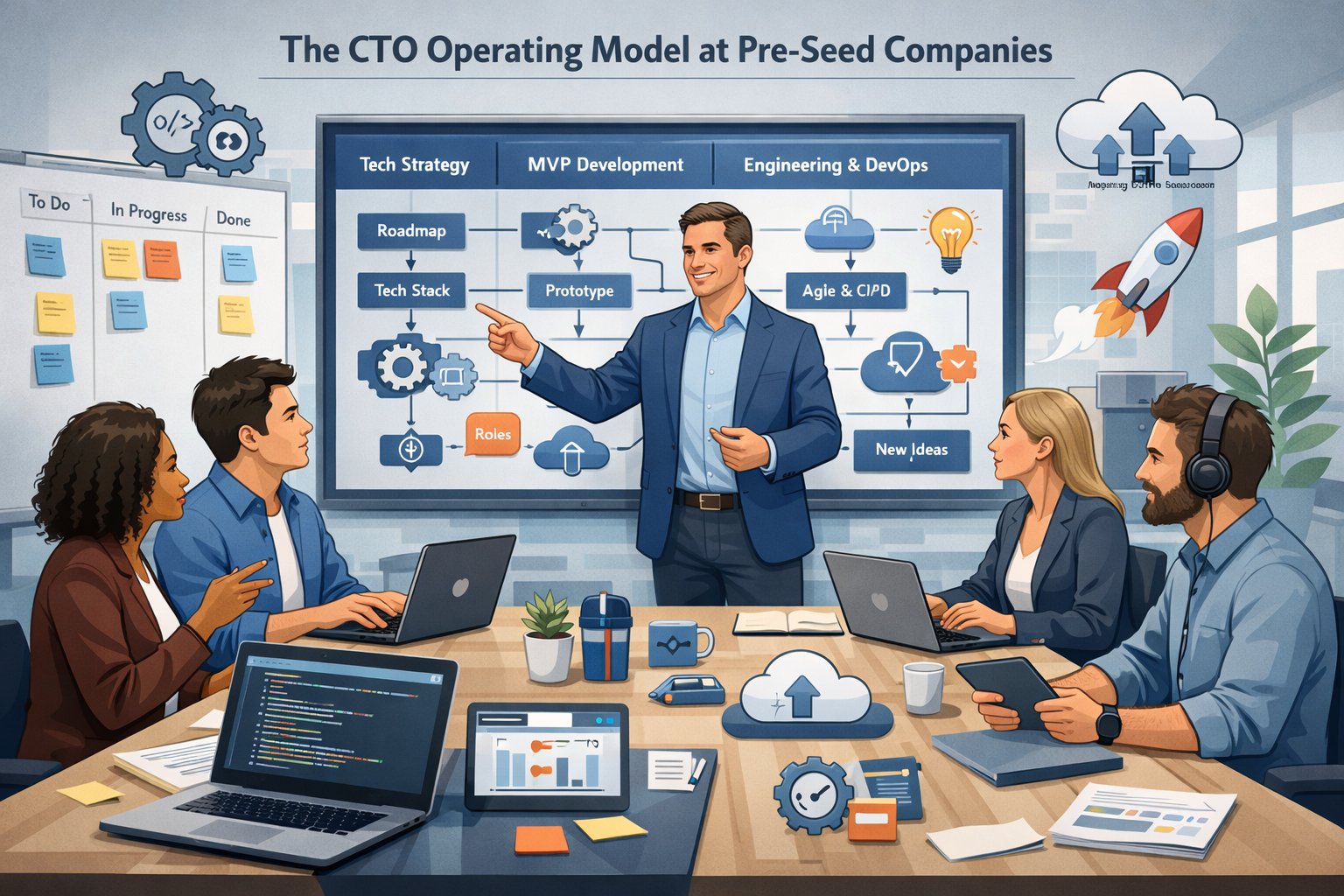
Stage-Specific CTO Responsibilities at Pre-Seed
At pre-seed, the CTO is both architect and builder, working with almost no resources. The job is to ship an MVP fast, make decisions you can reverse, and keep building with a tiny team and budget.
Technical Leadership Versus Technical Co-Founder
Pre-seed startups need a technical co-founder who codes every day - not just a delegator. The technical co-founder’s job is to build from scratch and iterate fast toward product-market fit.
| Role Type | Main Activity | Time Coding | Decision Authority | Equity Range |
|---|---|---|---|---|
| Technical Co-Founder | Writes features, deploys, debugs | 60-80% | Full stack/architecture | 10-25% |
| Fractional CTO | Advises, reviews, sets direction | 0-20% | Strategic guidance only | 0-2% + consulting fee |
| Full-Time CTO (hired) | Rare at pre-seed | Varies | Reports to founders | 1-5% + low salary |
Technical co-founders own everything: authentication, CI/CD, database, even late-night incidents.
Hiring a full-time CTO at pre-seed usually means the founders aren’t technical, or there’s extra capital to burn. Most startups can’t afford $150K+ salaries at this stage.
Fractional CTOs help cash-strapped startups bridge the gap to seed when you need advice but can’t pay for a full-time leader.
MVP Development and Time to Market
Speed beats elegance at pre-seed. The CTO’s job: ship a testable product in 6-12 weeks, not 6 months.
Core MVP tasks:
- Build one deployable app with a single database
- Add user authentication and basic security
- Set up staging and production
- Turn on error logging and basic monitoring
- Write just enough docs for handoff
The technical co-founder should delay complexity until needed and keep code modular. Monoliths are fine here if organized.
Development velocity killers:
- Microservices too early
- Custom tools when SaaS exists
- Full test coverage before users
- Overdone deployment pipelines
- Distributed systems before scale
Beta users want working features, not perfect code. CTOs ship “ugly” but useful code, then refactor once there’s real usage.
Time to market affects runway. A 3-month MVP gives 9+ months to find PMF on a 12-month runway. A 6-month MVP? Only 6 months left to iterate.
Team Composition, Hiring, and Budget Constraints
Most pre-seed teams: 1-2 developers. The technical co-founder often starts solo or with one other engineer.
| Team Size | Composition | Monthly Tech Spend | Hiring Focus |
|---|---|---|---|
| 1 dev | Solo co-founder | $2K-5K (tools, hosting) | None - founder does it all |
| 2 devs | Founder + full-stack generalist | $15K-25K (salary + tools) | Backend or frontend skill gap |
| 3 devs | Founder + 2 engineers | $30K-45K (2 salaries) | Product-minded, end-to-end builder |
Tech budgets rarely top $50K/month. CTOs must be realistic - equity matters more than salary now.
First hire must:
- Ship features solo within a week
- Fill founder’s technical blind spots
- Work with little direction or clarity
- Take below-market pay for real equity (0.5-2%)
Technical co-founders use real code reviews for hiring. Candidates do a bug fix and a small feature in the interview.
Don’t hire until you’re truly blocked on shipping. You should feel behind before adding people.
Product-Market Fit and Rapid Iteration
Pre-seed CTOs care about learning speed, not scale. Every tech choice should help you iterate faster based on user feedback.
PMF technical priorities:
- Deploy multiple times a day to get features to users
- Add user tracking from day one
- Use feature flags to test changes without full releases
- Avoid dependencies that slow down pivots
- Keep rollback under 5 minutes
Teams that ship daily learn faster than those shipping weekly.
Balance speed with stability. Breaking things for 10 beta users is fine. With 1,000 users, you need more caution.
Weekly metrics CTOs track:
- Deployment frequency (aim: 5+ per week)
- Time from idea to deployed feature (aim: <3 days)
- Critical bug fix time (aim: <4 hours)
- Beta user growth rate
- Feature adoption rates
User growth matters most at pre-seed. CTOs build features that boost engagement and retention, even if you’re not making money yet.
Rapid iteration means taking on technical debt in areas likely to change. Keep core systems like auth and data solid.
Building a Resilient and Compliant Tech Foundation
Wake Up Your Tech Knowledge
Join 40,000 others and get Codeinated in 5 minutes. The free weekly email that wakes up your tech knowledge. Five minutes. Every week. No drowsiness. Five minutes. No drowsiness.
Pre-seed CTOs must make architecture choices that avoid painful rewrites and set up security early to satisfy users and investors. These decisions affect deployment speed, reliability, and future scaling.
Selecting a Scalable Tech Stack and Architecture
Recommended Pre-Seed Stack
| Component | Tool/Service | Benefit |
|---|---|---|
| Frontend | Next.js | Server-side rendering, built-in API routes |
| Hosting | Vercel | Zero-config CI/CD, auto-scaling |
| Backend/Database | Supabase | Postgres, real-time, auth, storage |
| Error Tracking | Sentry | Debugging and performance monitoring |
| Analytics | PostHog | User metrics, no third-party tracking |
| Payments | Stripe | Fastest to revenue, minimal compliance |
| Financial Data | Plaid | Easy bank connections |
Architecture Rules & Examples
- Rule: Use managed services over self-hosted options when team is <3.
- Example: Choose Vercel over AWS EC2 for hosting.
- Rule: Start with a monolith, not microservices.
- Example: One Next.js app with API routes.
- Rule: Pick database for your data model, not hypothetical scale.
- Example: Use Postgres via Supabase for relational data.
Avoid custom infra or rare languages - they make hiring and audits harder.
Security Measures, Data Protection, and Compliance Roadmap
Minimum Security Checklist (First 2 Weeks)
- Multi-factor authentication on all production systems
- Role-based access control with least-privilege
- Encrypt data at rest and in transit
- Automated dependency scanning in CI
- Network access restrictions for database/admin
Data Protection Implementation Table
Wake Up Your Tech Knowledge
Join 40,000 others and get Codeinated in 5 minutes. The free weekly email that wakes up your tech knowledge. Five minutes. Every week. No drowsiness. Five minutes. No drowsiness.
| Priority | Requirement | Time | Tools/Approach |
|---|---|---|---|
| Critical | User auth security | 3-5 days | Auth provider with session management |
| Critical | PII encryption | 2-3 days | DB encryption, encrypted backups |
| High | GDPR basics | 5-7 days | Data export APIs, consent logging |
| High | Security monitoring | 1-2 days | Alerts for failed logins, anomalies |
| Medium | Pen testing | Quarterly | Third-party audit before Series A |
Compliance Triggers (Rule → Example)
- Rule: GDPR applies if you collect EU user data, even pre-revenue.
- Example: Add consent logging as soon as you sign up EU users.
- Rule: Start SOC 2 paperwork at least 6 months before Series A.
- Example: Begin documentation as soon as you have paying customers.
- Rule: Regulated industries (health, fintech, edtech) need earlier compliance.
- Example: Hire compliance consultant pre-seed if handling health data.
Security improvements must not block product velocity. Set up resilient IT from day one - don’t try to bolt it on later.
Technical Efficiency, Velocity, and Managing Debt
Deployment and Development Velocity Standards
| Metric | Pre-Seed Target | Warning Threshold |
|---|---|---|
| Deployment frequency | 5–10x per week | Less than 2x per week |
| Time to deploy | Under 10 minutes | Over 30 minutes |
| Automated test coverage | 40–60% critical paths | Under 30% |
| Sprint cycle length | 1 week | Over 2 weeks |
| Production incidents per week | 0–2 minor | 3+ or any critical |
Technical Debt Management Framework
Acceptable debt at pre-seed:
- Manual admin tasks affecting fewer than 5 ops each week
- Hard-coded config for features with under 100 users
- Missing edge case handling for <2% of usage
- Docs missing for experimental features
Unacceptable debt (fix ASAP):
- Security holes in auth or data access
- Performance issues hurting onboarding rates
- Data bugs that break transaction tracking or reports
- Reliability issues causing >1% error rates
Automation Priority Matrix
- Automate first: Deploy pipelines, DB backups, error alerts
- Automate second: User onboarding emails, basic reports, data exports
- Automate later: Internal tools, admin workflows, analytics dashboards
| Tech Efficiency Patterns | Tracking Metrics |
|---|---|
| Focus on deploy speed | Deployment frequency, incident rates |
| Skip story points | - |
Technical Partners and Expertise Acquisition
| Partner Type | Use Case | Typical Engagement |
|---|---|---|
| Senior contractors | Specialized integrations | 2–4 weeks |
| Technical advisors | Compliance planning | As needed |
| Fractional security experts | Security reviews | Quarterly |
| Documentation Rule | Example |
|---|---|
| CTO must document all architecture and roadmap changes | "Added Redis cache for session storage - 2024-03-10" |
Frequently Asked Questions
| FAQ Topic | Key Considerations |
|---|---|
| CTO role scope | Team size, runway, product-market fit |
| Technical priorities | Core product, security, workflows |
| Team building | Scaling engineering teams |
| Shift to leadership | When to move from execution to leadership |
What are the primary roles and responsibilities of a CTO in a pre-seed startup?
| Responsibility | Execution Mode | Time Allocation |
|---|---|---|
| Write/ship core code | Builder | 50–70% |
| Stack/architecture decisions | Owner | 10–15% |
| Set dev standards | Norm setter | 5–10% |
| Security/reliability | Enforcer | 5–10% |
| Translate tech to founders | Bridge | 10–15% |
| Hard Rule | Example |
|---|---|
| CTO builds core product from scratch and iterates rapidly | "Launched new onboarding flow and tested with 10 users" |
Weekly Must-Do Tasks:
- Ship or unblock one core feature
- Review all PRs in 24 hours
- Document one architecture decision
- Implement a security/reliability safeguard
- Update co-founders on technical progress/blockers
| Delegation at Pre-Seed | Typical Team Size |
|---|---|
| CTO owns critical path code | 1–3 devs |
How does the CTO's role evolve as a pre-seed company progresses towards later funding rounds?
| Stage | Team Size | CTO Coding % | Primary Shift |
|---|---|---|---|
| Pre-seed | 1–2 devs | 70–80% | Solo builder |
| Seed | 3–5 devs | 50–60% | Builder + mentor |
| Series A | 6–15 devs | 30–40% | Architecture + hiring |
| Series B | 15–30 devs | 10–20% | Strategy + management |
Role Transformation Markers:
- 1st engineer: shift 20% time to onboarding/code review
- 3rd engineer: assign module ownership
- 5th engineer: start hiring pipeline, formalize roadmap
- Series A: move from IC to team leader
| Rule | Example |
|---|---|
| Each new dev reduces CTO coding by ~10% | "With 4 devs, CTO codes 50% of the week" |
What are the key technical decisions a CTO must make in the early stages of a startup?
Infrastructure Choices:
- Monolith vs. microservices (almost always monolith at pre-seed)
- Cloud provider (AWS, GCP, Azure)
- Database (relational vs. doc store)
- CI/CD pipeline tool, staging setup
- Managed vs. self-hosted services
Development Choices:
- Core language/framework
- Code review/merge policies
- Testing coverage (unit, integration, E2E)
- Error logging/monitoring tools
- Version control workflow
Build vs. Buy:
- Auth (custom vs. Auth0/Clerk)
- Payments (Stripe vs. custom)
- Email (SendGrid/Postmark vs. SMTP)
- Analytics (Mixpanel/Amplitude vs. custom)
| Rule | Example |
|---|---|
| Favor managed services and proven tools | "Used Auth0 for login instead of building in-house" |
| Bad early choices create expensive debt | "Custom auth system took 2 months to replace after PMF" |
How should a pre-seed CTO balance hands-on technical work with strategic planning?
| Activity Type | Weekly Hours | Non-Negotiable Threshold |
|---|---|---|
| Writing prod code | 20–30 | Must ship one feature per week |
| Code review/unblock | 5–8 | Same-day PR response |
| Architecture docs | 2–3 | One decision doc per month |
| Security/reliability | 2–4 | Weekly backup check |
| Founder comms | 3–5 | One tech update per week |
| Strategic planning | 2–4 | Monthly roadmap refresh |
Execution Prioritization:
- Ship features that unblock customers/fundraising
- Fix prod incidents within 2 hours
- Review code in 24 hours
- Document hiring/scaling decisions
- Defer or delegate everything else
| Rule | Example |
|---|---|
| CTOs spending >30% on strategy have low technical output | "Spent 40% on planning, shipped no features last week" |
Time Protection Tactics:
- No-meeting Tuesdays/Thursdays for coding
- Batch code reviews (morning & late afternoon)
- 25-min decision docs (avoid 3-hour sessions)
- 15-min weekly founder syncs (skip daily standups)
| Expansion Trigger | Result |
|---|---|
| First engineer joins | CTO shifts time to mentoring and planning |
Wake Up Your Tech Knowledge
Join 40,000 others and get Codeinated in 5 minutes. The free weekly email that wakes up your tech knowledge. Five minutes. Every week. No drowsiness. Five minutes. No drowsiness.